Legal & Financial Investigation

Can Private Detective Evidence Be Used in Indian Courts?

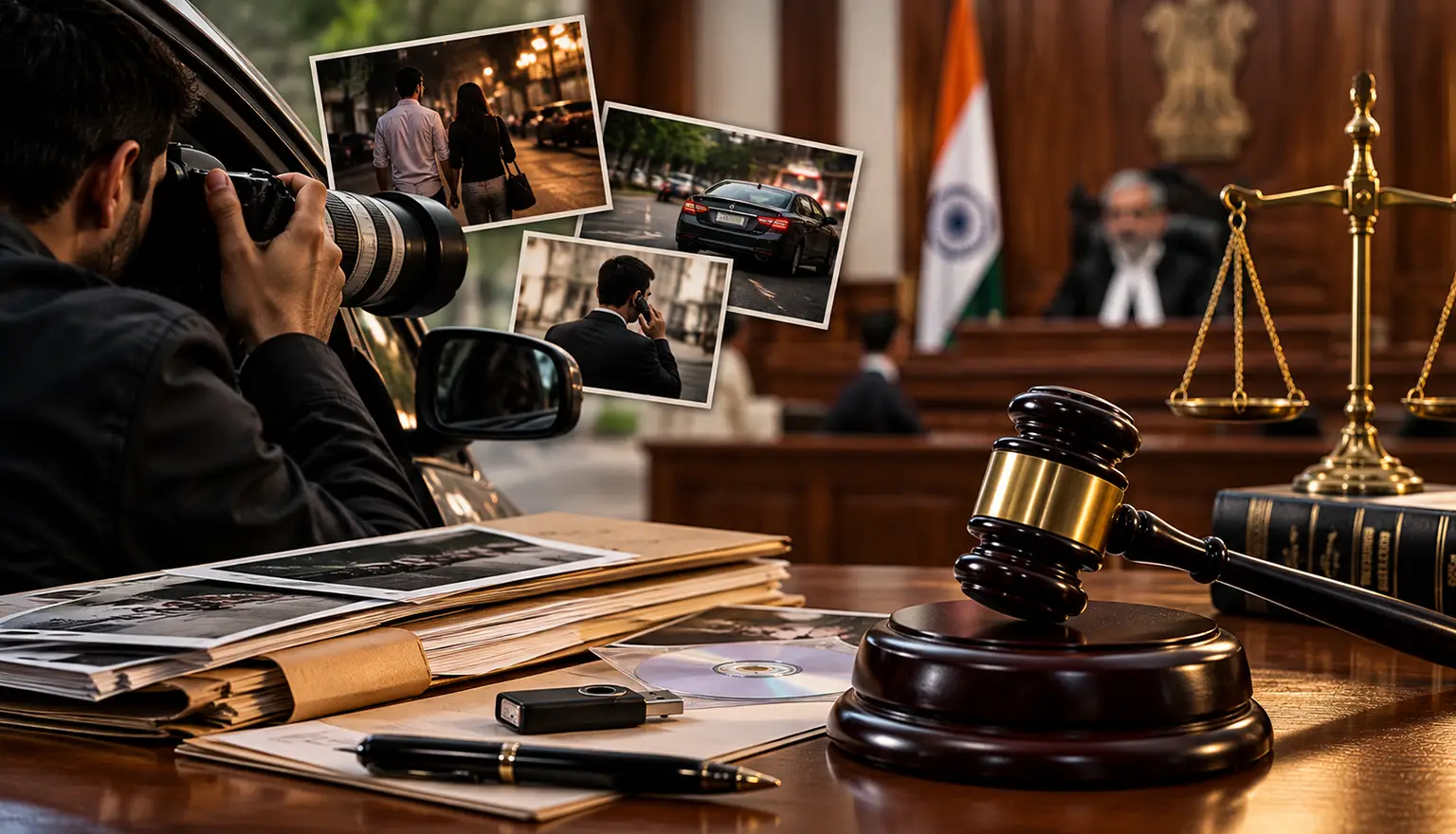
Lawyer reviewing private detective evidence before an Indian court hearing

Yes, private detective evidence in Indian courts can be used, but a judge never accepts it automatically. The evidence must be relevant, lawfully collected, properly authenticated and proved through the detective’s own testimony. Digital material such as photos and videos also needs a Section 63 certificate under the Bharatiya Sakshya Adhiniyam, 2023 (BSA).

This guide explains what Indian law says, what the Supreme Court said in July 2026, and how to make detective findings stand up in court.

Key takeaways

  • No Indian law bans private detective evidence, but courts test it like any other proof.
  • A private detective report is not enough alone. The detective usually has to testify.
  • Photos, videos and recordings need a Section 63 BSA certificate.
  • Illegal methods such as phone tapping or trespass can damage your case.

Is Private Detective Evidence in Indian Courts Admissible?

No statute bans it. Admissibility depends on the ordinary rules of evidence: relevance, authenticity and proper proof. Indian courts have also traditionally admitted relevant material even when it was obtained improperly. So the real question is not whether a detective was involved. It is whether the evidence can be trusted.

However, private detectives have no formal legal standing. In Navinchandra N. Majithia v. State of Meghalaya (2000), the Supreme Court said the Code of Criminal Procedure does not recognise private investigating agencies. Their findings are not an investigation under law, and a Public Prosecutor cannot present them, although a defence may. India also has no central licensing law. The Private Detective Agencies (Regulation) Bill, 2007 was introduced but never became law.

What the Supreme Court Said About Private Detectives in 2026

On 31 July 2026, in HC v. State of Rajasthan (2026 INSC 778), Justices Sanjay Karol and Vipul M. Pancholi examined a maintenance dispute. A husband had relied on about 92 videos and 237 photographs to allege his wife’s extramarital relationship. The Court suspected private investigators had gathered them.

92

videos placed before the court

237

photographs placed before the court

It did not decide the value of the material and sent the application back for a fresh decision. However, it asked pointed questions. Who took the images? Were they authorised? How were they stored? Are they genuine or doctored? What do they mean for privacy? The Court called private investigation an “area sans regulation” and sent the judgment to the Ministry of Law and Justice and the Law Commission of India. You can read the full report on Verdictum.

Courts will now look harder at who gathered evidence and how.

Section 63 BSA: Making Photos, Videos and Recordings Admissible

Most detective evidence is electronic. Since 1 July 2024, Section 63 of the BSA has replaced Section 65B of the Indian Evidence Act, 1872. A certificate in the prescribed Schedule format must accompany electronic records, and it must give the record’s hash value. In Arjun Panditrao Khotkar (2020), the Supreme Court held the certificate mandatory. The 2026 bench repeated that point.

The Malkani test for recordings: relevance, voice identification, and proof that the recording was not altered.

Recordings face one more test from R.M. Malkani v. State of Maharashtra (1973), summarised above. For photos and videos, the 2026 bench read identification as verifying the source.

Is a Private Detective Report Admissible in Court?

Not by itself. A report is the detective’s own statement, so courts generally treat it as hearsay unless the detective steps into the witness box and faces cross-examination. In practice, the report guides your lawyer. The detective’s sworn testimony, dated field notes and original files carry the weight. An agency that cannot send its investigator to court leaves you with paper the other side can dismiss.

Privacy, Illegal Methods and Vibhor Garg v. Neha

In Vibhor Garg v. Neha (14 July 2025), the Supreme Court held that a spouse’s secretly recorded phone calls were admissible in matrimonial proceedings. That case involved a spouse’s own recording. A detective is a third party, so the privacy questions raised in 2026 apply with more force.

Illegal methods also carry personal risk. Phone tapping, hacking, hidden cameras in private spaces and trespass can expose both detective and client to criminal liability. The 2026 bench itself mentioned voyeurism allegations, now covered by Section 77 of the BNS. Even when a court admits such material, it may give it little weight.

How to Make Detective Evidence for a Divorce Case in India Court-Ready

Courts weigh quality, not volume. These habits help:

Get your evidence checked before you file

Free, confidential consultation. Written confidentiality commitment and a fixed cost before fieldwork starts.

Frequently Asked Questions

  • 1. Is private detective evidence valid in Indian courts?

    Yes, if it is relevant, lawfully collected and properly proved. The detective usually must testify, and digital files need a Section 63 BSA certificate.

  • 2. Can detective photos and videos be used in a divorce case?

    They can be offered as proof of cruelty or adultery. However, the court will check authenticity, the collection method and privacy before giving them weight.

  • 3. Do private detectives need a licence in India?

    No central law currently licenses them. The Supreme Court called the field unregulated in 2026 and asked the government to examine regulation.

  • 4. Can a court reject private detective evidence?

    Yes. A court can refuse it if it is irrelevant, unproven, lacks a Section 63 certificate or appears doctored.

Final Thoughts on Private Detective Evidence in Indian Courts

Private detective evidence in Indian courts is usable, but only when it is lawfully gathered and carefully proved. Choose an agency that documents its work, follows the law and will testify.

Confidential Case Files prepares court-ready findings through lawful methods, with a written confidentiality commitment. Contact Confidential Case Files for a free consultation, or call +91 99671 33103. You can also explore our forensic document analysis and personal background verification services.

Leave a Reply

Your email address will not be published. Required fields are marked *